 By
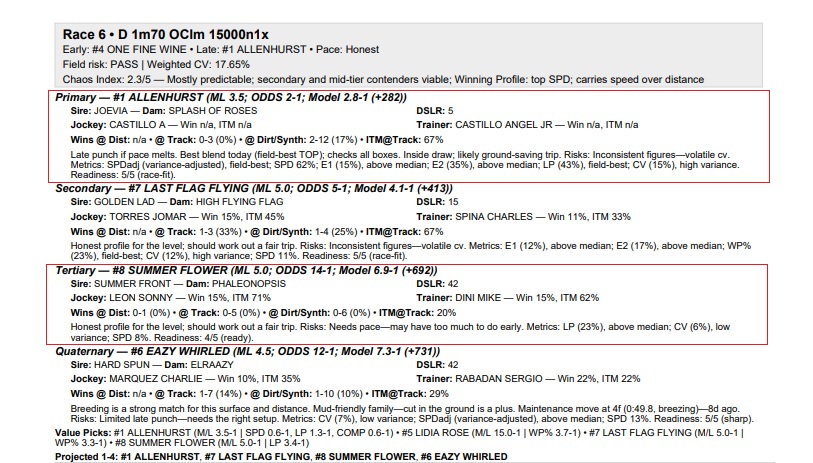
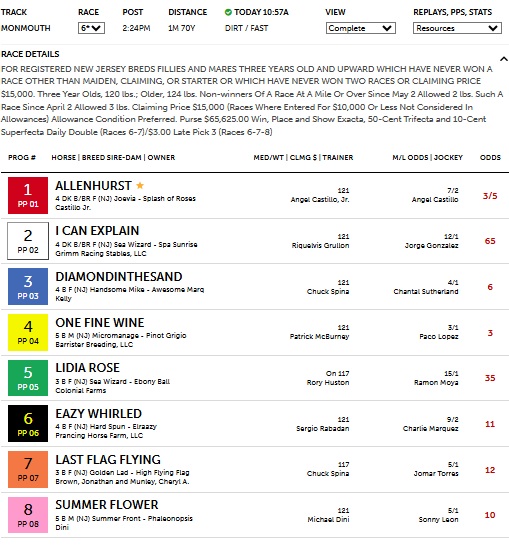
By Race 6 at Monmouth on Saturday illustrated the value of Track-IQ’s probabilistic approach in not only containing the winning exacta horses within its P/S/T/Q tier structure but also identifying that race favorite #1 Allenhurst was significantly overvalued at 3-5 compared to the model’s theoretical odds of 2.8-1. In situations where a favorite is heavily overbet—even relative to its 7-2 Morning Line—a reverse-wheel betting strategy can capitalize on the favorite’s overpricing and the underpricing of other contenders. The model’s Secondary, Tertiary, and Quaternary selections—#7 Last Flag Flying (12-1), #8 Summer Flower (10-1), and #6 Eazy Whirled (11-1)—were all undervalued relative to their fair-value odds of 4-1, 7-1, and 7.3-1, respectively.
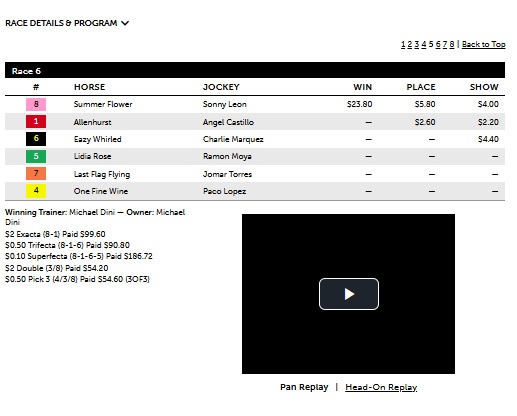
The race largely validated that assessment. Summer Flower produced a strong wide rally from off the pace to take command in the stretch and draw clear for the victory. Allenhurst overcame early pulling and finished well but had to settle for second, while Eazy Whirled rallied from off the pace to complete the trifecta. Here a $2 or $3 exacta wager with the reverse wheel (i.e.,S,T,Q/P) produced a $50 win with the $2 ex. paying $99.60.
What separates Track-IQ from many traditional handicapping products is its emphasis on probability and valuation rather than simple rankings or indicator-based selections. Services such as Winning Ponies provide useful handicapping indicators and rankings, but they generally do not convert those assessments into precise fair-value odds for every horse in the field. Without fair-value odds, bettors are left knowing which horses a system prefers but not whether those horses represent value at the prices being offered by the wagering public. Track-IQ’s probabilistic architecture generates theoretical odds for every entrant, allowing direct comparison between model value and tote board value. That capability transforms handicapping from merely picking horses into identifying market inefficiencies. In races such as this Monmouth event, the model recognized Allenhurst as a vulnerable favorite while simultaneously highlighting value among longer-priced contenders, creating a reverse-wheel opportunity that would have been difficult to identify through indicator-based approaches alone.

 Pro-Handicap Analytics